
Here’s something most students don’t expect: short-answer questions are often where the easiest marks in the whole A Level Law paper go missing. Not because the law is hard. Not because students haven’t revised. It’s because they walk into these questions thinking they’re simple, and simple questions get sloppy answers.
If you’re sitting Cambridge A Level Law 9084, this is worth fixing early. Short-answer marks are some of the most predictable on the whole paper, once you know what examiners are actually checking for.
Where the Marks Actually Go Missing
Mark a hundred short answers and you’ll see the same three problems over and over.
First, students describe the law in vague, everyday language instead of using the precise legal wording examiners are trained to look for. Second, they state a rule but forget to back it up — no case, no section, no statute, nothing an examiner can tick off. Third, and this one catches out even strong students, they ignore what the command word is actually asking for. They “describe” when the question said “explain.” They write three paragraphs when the marks available suggest three sentences would do.
None of these are knowledge problems. They’re technique problems. Which is good news, because technique is fixable.
Start With the Command Word — Every Time
Every short-answer question in A Level Law is built around a command word, and that word is basically the examiner telling you what to do. Skip past it and you’re guessing.
State or identity means give the fact, the rule, the definition — no reasoning required, just the answer. Explain means you need the rule plus why it works that way or how it operates. Describe usually wants a process or sequence set out clearly. Analyse asks you to pull something apart and show how the pieces connect.
Get this wrong and you can write a perfectly accurate answer that still loses marks, simply because it wasn’t the kind of answer that was asked for.
A Structure Worth Memorising
There’s a pattern that shows up again and again in answers that score well, and it’s not complicated:
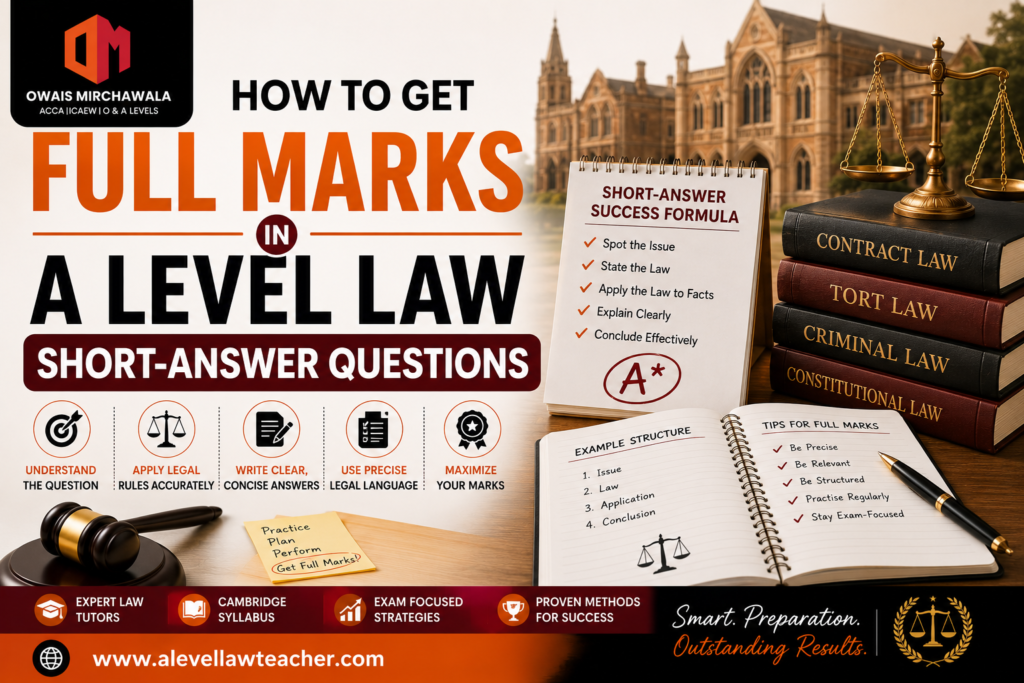
State the rule clearly, using proper legal terminology. Back it up with the case or statute that supports it. If the command word calls for it, explain or apply that rule to what the question actually gave you. Then stop — don’t keep writing once the point is made.
Why does this work so reliably? Because most mark schemes for short-answer questions are built the same way underneath — a mark for the rule, a mark for the authority, a mark for the explanation or application. Miss one of those three and you’ve left a mark on the table, no matter how confident the rest of your answer sounds.
Say It Like a Lawyer, Not Like a Summary
“The person didn’t mean to do it” is not the same as “the defendant lacked mens rea,” even though they mean roughly the same thing. Examiners are trained to reward the second version and not the first. It sounds like a small thing, but across a whole paper it adds up to real marks. Get comfortable using the actual terms from your syllabus — actus reus, consideration, ratio decidendi, ultra vires — instead of reaching for the plain-English version under exam pressure.
Never Leave a Point Unsupported
A rule without a case or section behind it reads as an opinion, not law. Even in a two-mark question, naming the authority matters. And if the exact case name slips your mind mid-exam, don’t panic and leave it blank — refer to the principle the case established instead. That’s still worth something. A blank space is worth nothing.
Take contract law as an example. Writing “both parties need to agree to something of value” is a start, but it’s incomplete on its own. A stronger answer names the case that establishes the consideration principle, then briefly shows how it applies to the scenario in front of you.
So How Much Should You Actually Write?
Not as much as you think. Write to the marks, not to fill space. A two-mark question needs two or three sharp sentences — nothing more. A five- or six-mark question needs room for the rule, the authority, and the explanation, but padding past that wastes time you’ll want later in the paper.
Before writing anything, glance at the marks on offer. Then mentally count out that many distinct points you need to hit. It sounds mechanical, but it works.
What AO1 and AO2 Are Really Testing
Cambridge papers assess against specific objectives, and short-answer questions usually test two of them side by side.
AO1 is knowledge and understanding — can you state the rule accurately, using the right terms? AO2 is an application — can you actually connect that rule to the question in front of you, rather than just reciting it in the abstract?
A lot of students only ever pick up AO1 marks. They know the law cold, but they explain it in a vacuum instead of tying it back to what the question specifically asked. Before you finish an answer, reread the question one more time and check that every sentence is actually doing work toward it.
Mistakes Worth Watching For
A few habits quietly cost students marks every exam season: writing everything they know about a topic rather than answering what was asked; forgetting the case or statute an answer needed; ignoring the command word and defaulting to “describe everything” mode; spending too long on early short answers and running out of time later; and submitting an answer without checking it actually matches the scenario given in the question.
Before You Walk Into the Exam
Read the command word twice before writing a word. Plan the answer in your head using rule, authority, and application. Keep your sentences short and precise rather than descriptive and sprawling. Let the marks available guide how much you write, not how much you happen to know. And with each answer, take a few seconds at the end to check it actually answers what was asked.
Full marks on A Level Law short-answer questions were never really about writing more. They come from giving the mark scheme exactly what it’s looking for, in roughly the order it expects. Get the command words right, always back your points with authority, and keep applying the law precisely to the question — and this section becomes one of the most reliable places to pick up marks on the entire paper.