
Ask any A Level law teacher what separates a grade A script from a grade C one, and most won’t point to the conclusion. They’ll point to the first paragraph. By the time an examiner has read your opening four or five sentences, they already have a rough sense of where your mark is heading — and that’s before you’ve cited a single case.
I’ve marked enough scripts to know why. Students often spend the first minute or two of an exam writing themselves into the answer rather than starting in it. They describe the scenario the examiner already wrote. They open with something like “law plays an important role in society,” which is true and also completely useless. None of that earns marks. What earns marks is precision, right from line one.
So here’s how to actually do it — how to write an A Level law essay introduction that does its job without wasting your limited exam time.
What the Introduction Is Actually For
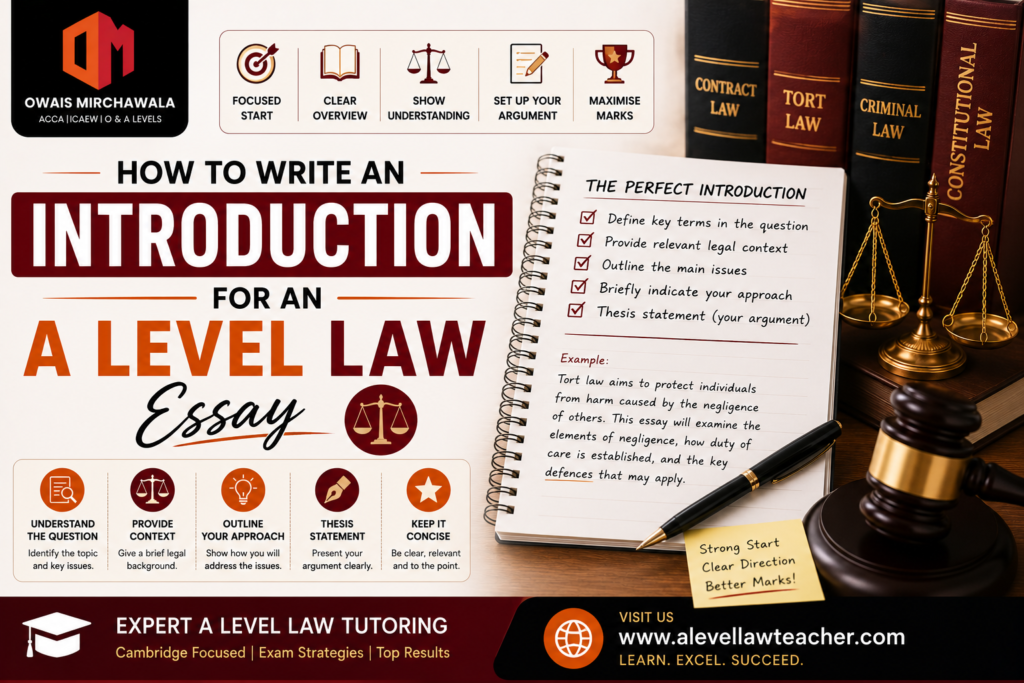
It’s tempting to think of the introduction as throat-clearing before the “real” essay starts. It isn’t. In a well-built A Level law essay, the introduction does three specific jobs at once: it shows you’ve correctly identified the legal issue, it defines the key concept the question turns on, and it tells the examiner what argument you’re about to make. If your opening paragraph does those three things, you’ve essentially told the examiner “I know what I’m doing” before you’ve written anything else.
This matters for exam technique generally, not just for style points. Cambridge examiners marking the 9084 syllabus are working through a lot of scripts in a short window. A confused opening makes them read the rest of your answer more skeptically. A confident, focused one does the opposite — it buys you goodwill for the paragraphs that follow.
Where the Introduction Fits in the Wider Essay
Before getting into the introduction itself, it’s worth seeing the shape of the whole essay, because the opening paragraph needs to set up everything that comes after it:
You start with the introduction, which frames the issue and states your argument. Then comes the main body, where you actually apply the law — cases, statutes, academic views — to the question in front of you. After that, a good essay pauses to consider the other side, whether that’s a counterargument, an alternative interpretation, or a criticism of the law as it stands. It finishes with a conclusion that comes back and directly answers the question, based on everything argued above.
The introduction is the promise. Everything else in the essay is you keeping it.
How to Actually Write It
Start by naming the issue, not describing it. Don’t retell the scenario. Say what area of law it sits in. If it’s a contract problem question, say so directly — “this scenario concerns the rules on offer and acceptance in contract formation” gets you into the answer in one sentence, rather than three sentences of recap.
Define the term the question hinges on. If you’re writing about consideration, actus reus, or parliamentary sovereignty, define it accurately and briefly, in your own words rather than a textbook quote. This does double duty: it shows understanding and it sets up the vocabulary you’ll use for the rest of the essay.
Commit to an argument. This is the step most students skip, and it’s the one that costs them the most marks. A single sentence stating your position is enough — something like “this essay will argue that while judicial precedent promotes certainty, its inflexibility can produce injustice in individual cases.” That sentence alone tells the examiner exactly where the essay is going, which makes the rest of your writing easier to follow and easier to mark well.
Don’t overwrite it. Four to five sentences is usually plenty for a 25–30 mark question. Every extra sentence in your introduction is a sentence you’re not spending on legal application, which is where the bulk of your marks actually sit.
A Working Template
If you want something concrete to practise with, this shape works for most 9084 questions, problem-based or discursive:
Sentence one names the legal issue. The next one or two define the key term. Then comes your argument, stated plainly. If you want a fifth sentence, use it to briefly flag how your answer will be structured — but this last part is optional, not essential.
Mistakes Worth Avoiding
The most common one is opening with a generic definition of “law” itself — examiners have read this a thousand times and it tells them nothing about your understanding of the actual question. Close behind that is restating the question almost word for word instead of engaging with it. A lot of essays also drift into description rather than analysis because there’s no clear argument stated up front, so the whole thing reads like a summary rather than a case being made. And then there’s the opposite problem: introductions that run too long, eating into time that should go toward legal analysis in the main body.
A Worked Example
Take a fairly typical 9084 essay question: “Discuss the extent to which the doctrine of judicial precedent promotes certainty in English law.”
A solid opening might read: “Judicial precedent — the principle that lower courts are bound by the decisions of higher courts in cases with similar material facts — is often defended as a guarantor of legal certainty. This essay will argue that while precedent does promote consistency and predictability, mechanisms such as distinguishing and overruling introduce a degree of flexibility that can undermine that certainty in practice.”
Two sentences. Definition, then argument. That’s really all it takes.
The Bottom Line
Getting the introduction right isn’t about writing something impressive-sounding. It’s about forcing yourself to think clearly before you start writing the rest of the essay — which, in practice, tends to make everything after it faster and sharper too. Practice this on past papers until naming the issue, defining the term, and stating your argument becomes something you do automatically, without having to think about it under exam pressure. Once that’s second nature, the rest of the essay — main body, counterargument, conclusion — tends to follow much more easily.