
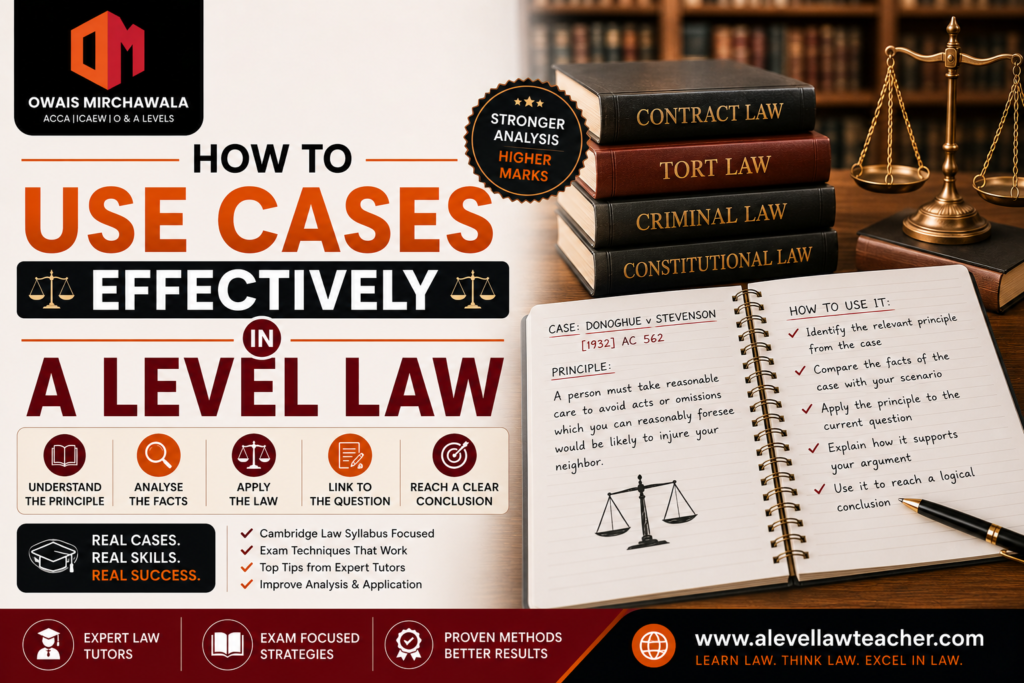
Ask most A Level Law students what separates a C grade essay from an A grade one, and they’ll probably say “knowing more cases.” That’s only half true, and honestly, it’s the less important half. I’ve marked enough scripts to know that the students who do best aren’t the ones who’ve crammed forty case names the night before. They’re the ones who know a handful of cases properly and actually know what to do with them once they’re on the page.
So this isn’t going to be another list of forty cases you should memories. It’s about technique — how to use case law in a way that actually gets you marks, especially if you’re sitting Cambridge A Level Law (9084).
Why bother with cases at all?
English law runs on precedent. Judges look at what’s been decided before and follow it, unless there’s good reason not to. So when you’re answering an essay question, you’re not just being asked “what’s the rule” — you’re being asked to show that the rule is real, that it’s been tested in an actual court, with actual facts.
Put simply: a rule with no case behind it is just you asserting something. A rule backed by the right case is an argument. That difference matters more than people think when an examiner is going through your script.
The basic structure that actually works
A lot of students treat cases like items on a shopping list — mention it, tick the box, move on. That’s not really using a case, that’s just naming one. Try this instead:
- State the rule.
- Bring in a case that supports it.
- Give the facts, briefly — you don’t need the full judgment.
- Say why the case matters for the question you’re actually answering.
That last step is where most marks get left on the table. Students will happily recall the facts of a case in detail and then just… stop. No link back to the essay question. It’s a bit like quoting evidence in court and never telling the jury why it matters.
Depth over breadth, every time
Here’s a question I get asked constantly: is it better to know loads of cases roughly, or a few really well? Go with the few. Every time.
Examiners want to see that you understand what a case actually decided and why — not that you can rattle off a case name under pressure. A workable target is three to five solid cases per topic, and for each one you should be comfortable with:
- The facts, in a sentence or two
- What principle it actually established
- Whether it’s been criticised or overtaken by later cases
Once you’ve got this for your main topics, revision gets a lot less stressful. You’re not trying to hold fifty names in your head — you’re recalling a smaller, well-understood set.
Exam technique that holds up under time pressure
When you’re thirty minutes into a timed essay and the clock’s against you, technique matters more than memory. A few things that consistently help:
Don’t lead with the case name. Start with the point you’re making, then bring the case in to back it up. The case supports your argument — it isn’t the argument itself.
Keep the facts short. One or two sentences is plenty. You’re not being marked on how well you remember a judgment.
Use language that signals understanding — something like “this is authority for…” shows the examiner you get why the case is relevant, not just that you remember it exists.
Don’t shy away from conflicting cases. A lot of A Level Law topics have cases that seem to pull in different directions. If you can explain why courts reached different outcomes on similar facts, that’s a strong sign of real understanding, not just recall.
Where students actually lose marks
Even good students slip up here. The usual culprits:
- Naming a case, then never explaining why it’s relevant
- Spending too long on facts that don’t add anything analytically
- Citing a case that’s since been overruled, as though it still stands
- Reaching for the same favourite case regardless of whether it fits the question
Fixing these habits often gets you further than learning five more cases would.
Making revision actually stick
Long paragraphs copied from a textbook don’t help much at 11pm the night before an exam. Short, structured revision cards work better. Something like:
- Case name
- One-line facts
- Principle it established
- Which topic it belongs to
Group these by topic rather than alphabetically. That’s how you’ll actually need to pull them out in the exam — you’ll see a question on a specific area, not a random case name floating in isolation.
A note for Cambridge 9084 students specifically
If you’re doing 9084, the mark schemes consistently reward accurate application to the scenario in front of you, backed by cases that are correctly explained — not just correctly named. When you’re working through past papers, pay close attention to which cases actually fit which fact patterns, rather than trying to squeeze a favourite case into every answer regardless of fit.
Timed practice essays are worth far more here than passive reading. You learn the difference between knowing a case and being able to use it under pressure.
Final thought
Using case law well in A Level Law isn’t really about volume. It’s about picking the right case, explaining it briefly and accurately, and always tying it back to the question in front of you. Get that habit right and case law stops being something you’re anxious about remembering — it becomes the thing that makes your essays genuinely convincing.
Frequently Asked Questions
How many cases should I know for A Level Law?
Fewer than you’d think, if you know them well. Three to five per topic, properly understood, beats a long list you can barely explain.
Do I need to remember exact case facts?
Not word for word. A short, accurate summary is enough — examiners are marking your application, not your memory.
What’s the biggest mistake students make with case law?
Naming a case and never explaining why it matters. Always tie it back to the question you’re answering.